Online Dating Safety After 50: How to Date Online Without Losing Your Common Sense
Online dating can introduce you to people you'd probably never meet in everyday life.
That's one of the best things about it.
It also means you're being introduced to complete strangers.
That's not a reason to avoid online dating.
After all, the interesting person you meet at a party, in a pub or at a singles event is technically a stranger too.
But online dating gives us something slightly different.
We can feel as though we know somebody before we've actually met them.
You've exchanged messages.
You've laughed at the same things.
They've told you about their children, their job and the dog they apparently adore.
You've been messaging every evening for two weeks.
It can start to feel like a relationship is developing.
But until you've met them - and often for quite some time afterwards - you're still getting to know them.
So let's talk about staying safe without turning online dating into an episode of Crimewatch.
If you haven't even chosen where you'd like to date yet, start with my guide to the Best Dating Sites & Apps for Over 50s in the UK.
Keep Some Personal Information Personal
You don't need to hand somebody your complete identity in order to have a conversation.
Be particularly careful about sharing things such as:
your full home address
exactly where you work
financial information
passwords or security information
information that could help somebody access your accounts
details about when your home will be empty
This doesn't mean answering every question with:
CLASSIFIED INFORMATION.
Just let trust build gradually.
There is no reason somebody you've exchanged six messages with needs to know your exact address.
Look at What's in Your Photographs
We covered this in Dating Profile Photos After 50, but it's worth repeating because photographs can reveal more than we realise.
Before uploading one, look at the background.
Can you see your house number?
Car registration?
Work badge?
Grandchild's school uniform?
An envelope with your address?
Most of the time there'll be absolutely nothing concerning there.
It's simply worth checking.
Don't Be Rushed Off the Dating App
This is one I want you to take seriously.
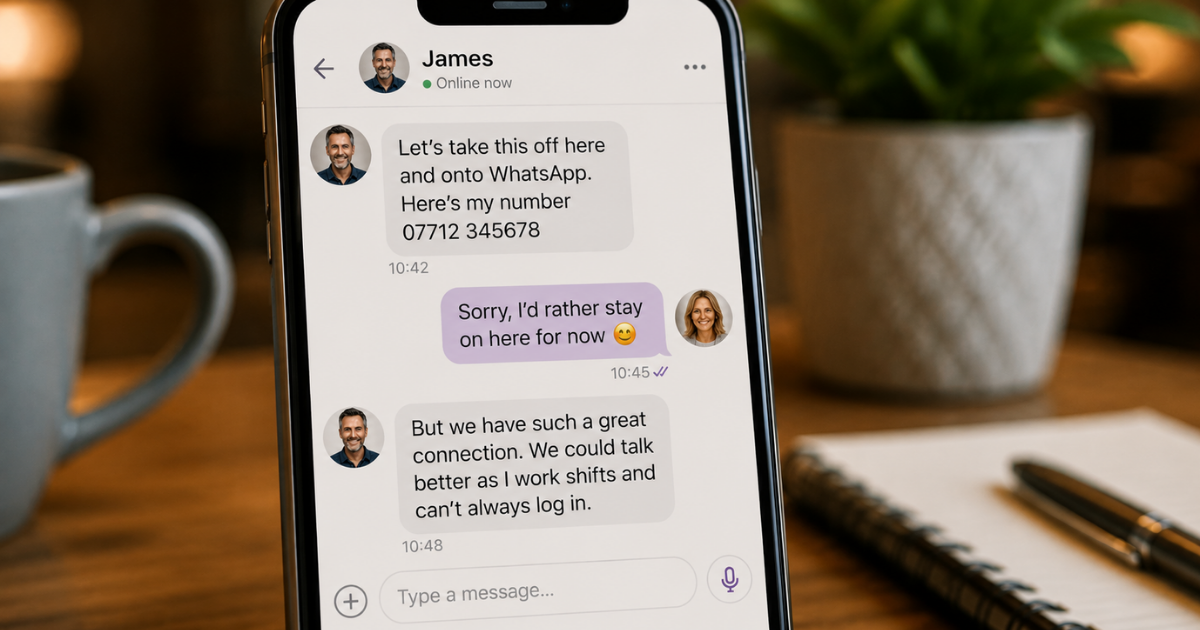
It's quite common for somebody to suggest moving from the dating app to WhatsApp, text or another messaging service. There can be perfectly innocent reasons for that - dating apps aren't always the easiest places to have a conversation.
But be wary of somebody who is very keen to get you off the dating platform almost immediately.
Scammers will sometimes try to move the conversation elsewhere quickly because once they have you communicating privately, they can delete their dating profile or disappear from the platform. That can make it harder for you to go back and look at their profile, report what happened or notice that information has suddenly changed.
And the pressure can be surprisingly convincing.
Suddenly there's a reason they can't communicate normally.
They're working abroad.
They're away with work.
They work unusual shifts.
They're only available to message at strange times.
There's always an explanation for why you can't quite speak to them or meet them in the ordinary way you'd expect.
And sometimes they can be very persistent about moving the conversation elsewhere.
I've experienced this myself twice.
Neither person got anything from me, but that doesn't mean it wasn't intimidating. When somebody you don't really know becomes pushy about having greater access to you, it can feel genuinely unsettling.
So don't worry about appearing rude.
You can simply say:
“I'd rather keep chatting on here until we've got to know each other a little better.”
A genuine person may prefer WhatsApp, but they should be able to respect that boundary.
And while you're still on the dating platform, you also retain something important: the platform's block and report tools and a record of the profile you've been speaking to.
So if somebody is rushing you to WhatsApp after a handful of messages, won't accept that you'd rather stay on the app, and then starts giving you complicated reasons why they can't call, video chat or meet normally...
Don't explain those things away because you like them.
Slow it down.
And if the pressure continues, stop the conversation and report the profile.
A Video Call Can Be Useful
Before meeting somebody, a short video call can be a really useful halfway step.
Not because you're conducting an identity inspection.
But because it answers one fairly important question:
Is the person I've been talking to actually the person in the photographs?
It can also make that first real-life meeting feel much less daunting.
You've already seen each other move, heard each other's voices and had a proper conversation.
And if somebody repeatedly has reasons why they can never video call?
I'd at least wonder why.
Be Cautious If Their Story Doesn't Quite Add Up
You don't need to become an amateur detective.
But do listen to that little voice that says:
Hang on...
Perhaps details keep changing.
Their age doesn't match something they've told you.
Their job seems to alter.
They tell you they're in one place but later forget and say they're somewhere else.
One inconsistency doesn't automatically make somebody a scammer.
Humans forget things.
But repeated inconsistencies are worth noticing.
You don't have to explain away something that feels odd simply because you like them.
Be Careful With People Who Become Intense Very Quickly
Sometimes two people genuinely click immediately.
That's lovely.
But intensity can also be manufactured.
Be wary if somebody you've never met is already talking about:
fate
soulmates
being in love
spending your lives together
after a remarkably short amount of time.
Especially if the relationship seems to be racing ahead emotionally while somehow never progressing towards an ordinary real-life meeting.
Real connection can develop quickly.
But you're still allowed to slow things down.
Money Is a Very Big Red Flag
This one can be wonderfully uncomplicated.
Do not send money to somebody you've met through a dating app and don't properly know.
Not because:
their bank account has temporarily frozen.
Not because:
they're stranded abroad.
Not because:
their business payment hasn't arrived.
Not because:
their child has an emergency.
Not because:
they need money for a flight so they can finally come and meet you.
And definitely not because they've got an incredible investment opportunity they'd love to share with you.
If money enters an online romantic relationship before you've even built a genuine real-world relationship, stop.
Romance scams work because the scammer doesn't begin by asking for money.
They begin by creating trust and emotional attachment.
The request comes later.
Don't Ignore Pressure or Guilt
A healthy person can hear:
No.
They can also hear:
Not yet.
If somebody becomes angry, sulky or manipulative because you won't:
give them your phone number,
send a photograph,
tell them where you live,
meet immediately,
lend them money,
or become more sexual than you're comfortable with,
that's information about them.
You don't need to prove you're trusting.
And you don't owe somebody access to you because you've matched with them.
Meeting for the First Time
This is the bit where online dating becomes actual dating.
You've messaged.
Perhaps you've spoken on the phone or had a video call.
You like them enough to think:
I'd quite like to meet you.
Brilliant.
For the first meeting, choose somewhere public.
A café.
A pub.
A restaurant.
Somewhere with other people around.
I'd keep the first meeting relatively simple too.
Coffee or a drink gives you both an easy way to decide whether you'd like to see each other again without committing to a seven-course dinner and three hours together.
Tell Somebody Where You're Going
Tell a friend or family member:
who you're meeting,
where you're going,
and roughly when you expect to be home.
You can even arrange to message them afterwards.
This isn't being dramatic.
It's just sensible when you're meeting somebody you don't know.
Get Yourself There - And Get Yourself Home
For an early date, I'd avoid relying on the other person for transport.
If they collect you from home, they now know where you live.
And if they're your lift home, you're dependent on them to leave.
Drive yourself.
Use public transport.
Book a taxi.
Whatever works for you.
Just make sure you control when you arrive and when you leave.
Watch Your Drink

The same rules that applied when you were 25 haven't mysteriously expired because you're 55.
Keep an eye on your drink.
Don't leave it unattended.
And remember that alcohol also affects our own judgement.
You don't need to approach your date as though they're plotting against you.
Just use the same common sense you'd use on any night out.
Don't Let Weeks of Messaging Create False Intimacy
This is one of the more subtle online-dating risks.
You can know an extraordinary amount about somebody you've never met.
You've discussed childhood.
Relationships.
Divorce.
Dreams.
Family.
Perhaps you've flirted.
Perhaps you've spoken every night.
So when you finally meet, it can feel like you're meeting somebody you already know.
But there's a difference between knowing what somebody has told you about themselves and knowing them.
Meeting in person gives you information messaging simply can't.
How do they treat the staff?
Do they listen?
Do you feel comfortable around them?
Does their behaviour match the person you've been talking to?
Give real life time to catch up with the intimacy you've created online.
If Something Feels Wrong, You Can Leave
You don't need evidence.
You don't need to prove anything.
And you don't have to stay for another drink because leaving might seem rude.
If you're uncomfortable, leave.
Dating doesn't require you to override your own judgement in order to protect a stranger's feelings.
Blocking Someone Isn't Rude
If somebody becomes abusive, sexual, aggressive, manipulative or simply refuses to respect your boundaries:
block them.
If appropriate, report them to the dating platform too.
You don't need to write a four-paragraph explanation first.
There are situations where:
This isn't for me. Take care.
is perfectly adequate.
And there are situations where no final message is necessary at all.
What If They Just Stop Messaging?
That's different.
Somebody disappearing from a conversation isn't necessarily a safety issue.
It's unfortunately part of online dating.
If you're struggling with the messaging side - what to say, how to keep a conversation going and when to suggest meeting - read What to Say on a Dating App (So You Actually Get a Reply).
Safety Doesn't Mean Suspicion
I don't want you reading this and thinking:
Good grief. I'm never dating again.
Most people using dating apps are doing exactly what you are:
trying to meet somebody.
You don't need to assume everyone is lying.
You don't need to conduct background checks before agreeing to coffee.
And you don't need to turn every inconsistency into a crime documentary.
The aim is simply to keep your common sense switched on while your emotions are getting involved.
Take your time.
Keep some information private initially.
Meet publicly.
Control your own transport.
Don't send money.
Notice pressure.
And allow somebody's actions over time to show you who they are.
That's not being cynical.
That's dating safely.
And Remember - Online Dating Is Optional
If all of this makes you think:
I'd much rather meet somebody in a room full of actual humans...
you can.
Online dating is only one route.
There are singles socials, activities, groups, holidays, introductions and all sorts of ways to meet people away from a screen.
You can browse Singles Events Near You if you'd rather start there.
And if you're still wondering whether you're ready to date at all, take my free What Type of Single Are You? quiz.
