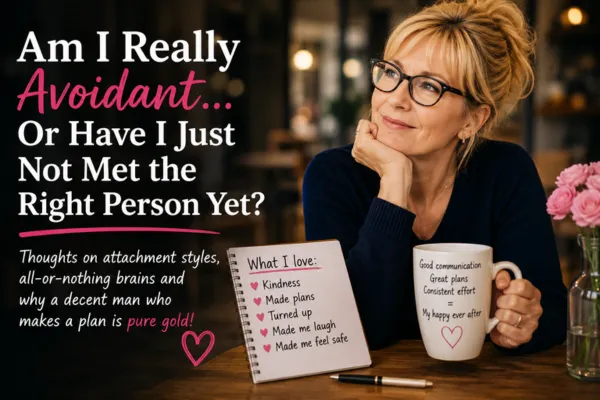
Am I Really Avoidant… Or Have I Just Not Met the Right Person Yet?
If social media is to be believed, half the population is avoidant, the other half is anxious, and the lucky few are secure.
I've lost count of the number of times I've heard someone say:
"He's avoidant."
"She's anxious."
"They have attachment issues."
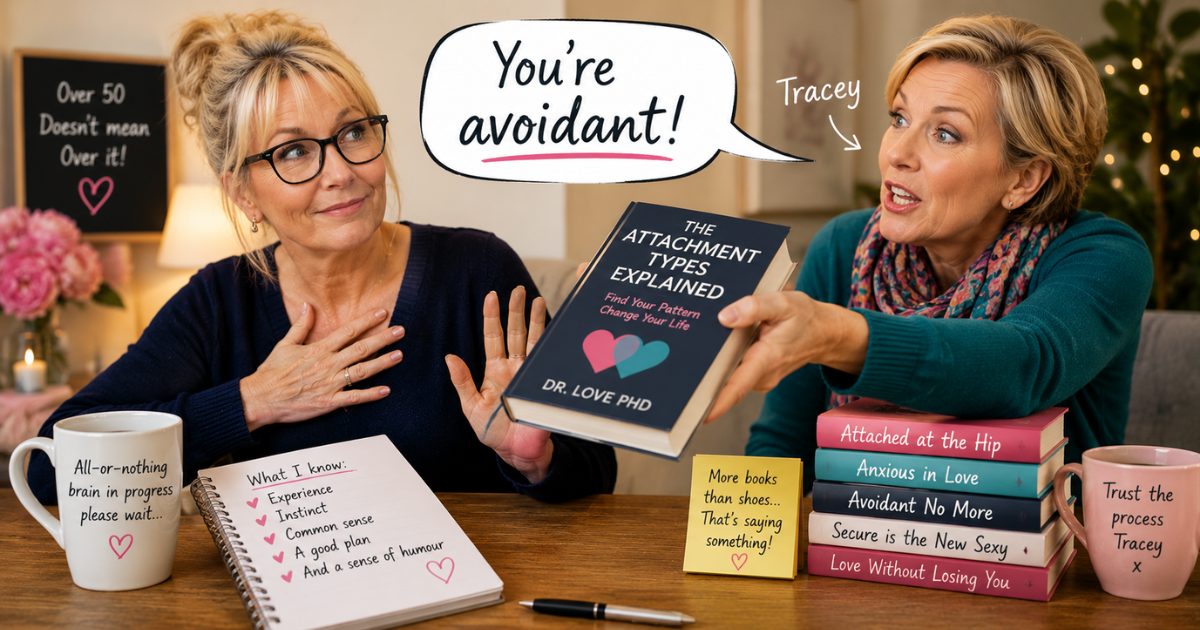
Now before Tracey appears with her collection of attachment theory books, let me be clear. I do think attachment styles can be useful.
Some people genuinely struggle with trust, intimacy or fear of abandonment. Understanding why we react the way we do can be incredibly helpful.
But I can't help wondering if we've started putting too many people into boxes.
For years I told people I was avoidant.
It seemed to fit.
After my marriage ended, I wasn't rushing into another relationship. I valued my independence. I enjoyed my own company. If things started getting serious too quickly, I'd often take a step back or run!
"Classic avoidant behaviour," according to the experts.
Except there was one problem.
Every now and then, the right man would come along.
And suddenly I wasn't avoidant at all.
Funny that.
The truth is, when I look back over my dating experiences, I've probably been all three attachment styles depending on who I was with.
I've been secure.
I've been anxious.
I've been avoidant.
If attachment styles are a thing, then I'm the bipolar bear of attachment styles.
One man made me feel completely relaxed. I knew where I stood. We communicated well. There was no drama.
Secure.
Another never planned anything.

He'd call and say, "What are you doing tonight?"
Now if you've got one of those all-or-nothing brains like mine, that's a recipe for disaster.
Tonight?
What do you mean tonight?
Where are we going?
What time?
Have you booked it?
What's the backup plan if it rains?
Suddenly I felt anxious.
Was that because of childhood wounds?
Or was it because he couldn't organise a coffee?
Then there were the men who brought out my avoidant side.
Not because I was afraid of intimacy.
Not because I was damaged.
Not because I needed years of therapy.
But because deep down I knew they weren't my happy ever after.
I wasn't pulling away from love.
I was pulling away from the wrong person.
That's a very different thing.
What I've learned after years of talking to singles is that sometimes we're too quick to label normal human reactions.
The woman who feels anxious because a man disappears for three days without replying might not have anxious attachment.
She might simply be responding to inconsistent behaviour.
The man who seems avoidant might not be afraid of commitment.
He might simply know this isn't the right relationship for him.
And the person who appears secure may simply have found someone who makes them feel safe.
At our age, I think we sometimes overcomplicate dating.
We're looking for hidden meanings, analysing every text message and diagnosing each other with psychological labels.
Meanwhile, many of us are just looking for someone who communicates, follows through and turns up when they say they will.
I don't know whether I'm anxious, avoidant or secure.
What I do know is this:
When someone makes an effort, communicates clearly, keeps their word and makes me feel valued, most of my attachment issues seem to disappear.
Maybe attachment styles are real.
Maybe they're useful.
But perhaps they're only part of the story.
Perhaps the bigger question isn't:
"What attachment style am I?"
Perhaps it's:
"Who am I when I feel safe, valued and genuinely wanted?"
Because that version of us might be the most authentic one of all.
Enjoyed This Article?
Modern dating can feel confusing, especially when every dating experience seems to come with a new label.
If you'd like more honest, down-to-earth dating advice (without the jargon), join the Love After 50 community and receive new articles, tips and resources straight to your inbox.
❤️ Ready for Love — What Happens Next?
If you're ready to have someone special in your life but you're not quite sure what comes next, explore our Ready for Love journey for ideas, resources and practical next steps.
