
Dating After 50 in the UK
Real advice, confidence and connection — at your own pace
Dating later in life often comes with a completely different set of questions and experiences compared with dating in our twenties or thirties.
Many singles over 50 are navigating new territory — whether that’s online dating, rebuilding confidence after a long relationship, or simply figuring out how people meet today.
This blog explores those topics through practical insights, shared experiences and ideas that can help you approach relationships with more confidence and curiosity.
Topics We Explore
Articles on Love After 50 cover subjects such as:
• dating after divorce
• rebuilding confidence
• understanding relationships
• meeting new people later in life
• communication and connection
• navigating modern dating
These topics are explored from the perspective of singles over 50 who are rediscovering relationships and connection at a new stage of life.
Start Exploring
Below you’ll find the latest articles exploring relationships, dating and connection later in life.
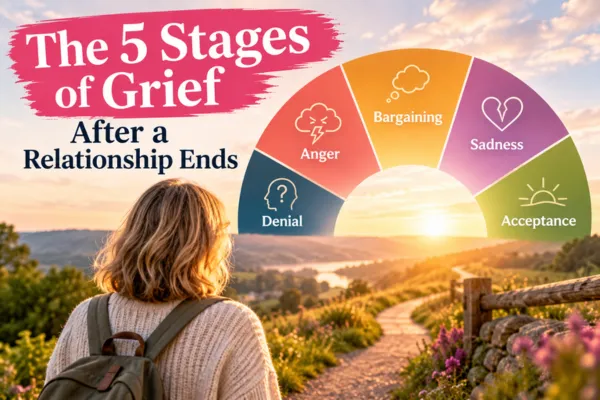
The 5 Stages of Grief After a Relationship Ends
When we hear the word grief, we usually think about bereavement.
But the end of a relationship can involve grief too.
You're not only losing a person.
You may be losing the future you thought you were going to have with them. Your routines. Your home. Your role as part of a couple. Shared friends. Financial security. Family traditions. Even the person you automatically told when something funny, annoying or completely insignificant happened during your day.
And whether the relationship lasted six months or thirty years, that loss can affect you in ways you weren't expecting.
You might feel devastated one day and furious the next.
You might feel strangely relieved.
Then miss them.
Then decide you're absolutely fine.
Then hear a song in the supermarket and suddenly find yourself standing next to the baked beans trying not to cry.
Grief isn't particularly interested in behaving logically.
And neither are we when we're going through it.
What are the 5 stages of grief?
You may have heard of the five stages of grief:
Denial. Anger. Bargaining. Sadness. Acceptance.
They can be a useful way of understanding some of the emotions we experience after loss.
But they're not a timetable.
You don't complete Denial on Tuesday, move neatly into Anger on Wednesday and eventually graduate from Acceptance with a certificate and a small round of applause.
It would be lovely if we did.
You can move backwards and forwards between them.
You can experience several at once.
You might not experience all five at all.
And sometimes you can think you've moved through something only for it to pop back up months later when you least expect it.
So rather than thinking of them as five steps you have to complete, I prefer to think of them as five emotional experiences you might recognise while you're adjusting to the end of a relationship.
1. Denial - “This can't really be happening”
Denial doesn't always mean literally refusing to believe the relationship has ended.
Sometimes it's much quieter than that.
You might carry on behaving as though nothing has really changed.
You might avoid telling people.
You might keep expecting their key in the door.
You might think:
They just need some space.
They'll realise they've made a mistake.
We'll sort this out.
Or you might throw yourself into work, family, decorating the house, going out - anything that means you don't have to sit still long enough to feel what's happened.
Denial can give us a little breathing space when reality feels too much to take in all at once.
Eventually, though, reality starts to settle.
And that's often when another emotion appears.
2. Anger - “How could they do this to me?”
Anger after a relationship ends can be enormous.
You might be angry with your ex.
Angry with yourself.
Angry about the years you invested.
Angry about money.
Angry about what they said.
Angry about what they didn't say.
Angry that they seem to be getting on with their life while you're trying to remember how yours is supposed to work now.
Sometimes the anger isn't even entirely about the other person.
It can be anger at the situation.
This isn't how my life was supposed to look.
And anger can occasionally feel easier than sadness because it gives us energy.
Sadness can flatten us.
Anger says:
Get up. Do something.
But if we stay there indefinitely, anger can also keep us emotionally connected to the very relationship we're trying to move beyond.
You don't have to pretend you're not angry.
But you also don't have to build your new life around it.
3. Bargaining - “What if...?”
Bargaining is the land of:
If only.
If only I'd tried harder.
If only I'd noticed sooner.
What if I'd been more affectionate?
What if we'd gone to counselling?
What if I hadn't said that?
What if I changed?
And sometimes:
What if we tried again?
Our brain starts rewriting the relationship, looking for the moment where we could supposedly have changed the ending.
This can be particularly difficult after a relationship where there wasn't one enormous event that ended everything.
No dramatic betrayal.
No huge argument.
Just two people gradually becoming disconnected.
Because if there isn't one obvious reason, the brain can spend an extraordinary amount of time looking for one.
Sometimes reflection is useful.
We can learn from relationships.
We can recognise things we'd do differently next time.
But there's a difference between learning from the past and repeatedly putting yourself on trial for it.
You were making decisions with the information, emotions and resources you had at the time.
You know more now because you've lived through it.
4. Sadness - “I really have lost this”
This is often the part people expect grief to look like.
Crying.
Loneliness.
Missing somebody.
But relationship grief can contain a particularly confusing kind of sadness because you may not even want the relationship back.
You can know, completely and absolutely, that ending it was the right thing to do...
and still grieve it.
You can miss someone you don't want to be with.
You can miss having someone beside you without missing them specifically.
You can miss Sunday mornings.
Holidays.
Inside jokes.
Cooking for two.
Having somebody to message when you've just seen something ridiculous.
You can even grieve the version of the relationship you wanted it to become, rather than the relationship it actually was.
That doesn't mean you've made the wrong decision.
It means something that mattered to you has ended.
And sometimes that hurts.
5. Acceptance - “This is my life now”
Acceptance doesn't necessarily mean:
I'm delighted the relationship ended.
It doesn't mean you never think about them.
It doesn't mean everything that happened suddenly becomes okay.
And it certainly doesn't mean you have to start dating again.
Acceptance is quieter.
It's when the relationship stops being the centre of every thought.
You begin making decisions without automatically factoring them in.
You start imagining a future that looks different from the one you'd planned -and that future doesn't feel quite so frightening anymore.
You might realise you've gone an entire day without thinking about them.
Then a weekend.
You start rediscovering bits of yourself.
And eventually the question begins to change from:
How am I going to live without this relationship?
to:
What do I want my life to look like now?
That's a very different place to be.
You can go backwards
This is probably one of the most important things to know.
You can feel as though you've reached acceptance and then suddenly find yourself furious again.
An anniversary appears.
You discover your ex is seeing somebody.
A family event feels strange without them.
You find an old photograph.
Someone asks an innocent question.
And suddenly an emotion you thought you'd dealt with comes wandering back through the door.
That doesn't mean you're back at the beginning.
Healing isn't a straight line.
Sometimes we're simply meeting an old feeling from a different place.
What if you're the person who ended the relationship?
You can still grieve.
This is something that isn't talked about enough.
Ending a relationship doesn't mean you don't care.
Sometimes people leave relationships they desperately wanted to work because they finally accept that they don't.
You can initiate a separation and still cry.
You can be relieved and heartbroken simultaneously.
You can love somebody and know you shouldn't be together.
Human emotions are quite capable of holding two apparently contradictory things at once.
And what if you feel relieved?
That's allowed too.
Not everyone is devastated when a relationship ends.
Sometimes the first feeling is relief.
Perhaps the relationship had been unhappy for years.
Perhaps you'd already done much of your grieving while you were still together.
Perhaps you've finally stopped trying to make something work that hadn't worked for a very long time.
Relief doesn't mean the relationship meant nothing.
And it doesn't mean grief won't appear later.
It simply means relief is part of your experience too.
How do you know when you're ready to move forward?
There's no magic amount of time.
Three months isn't automatically too soon.
Three years isn't automatically too long.
And being ready to move forward doesn't necessarily mean being ready for another relationship.
You might simply be ready to start building a life that feels like yours again.
That's actually one of the reasons I created my What Type of Single Are You? quiz.
Because “single” isn't one emotional state.
Someone who's heartbroken is in a very different place from someone who's beginning to come to terms with the end of a relationship.
And they're both in a different place from someone who's ready to date, ready for love, or genuinely happy being single.
Take the free What Type of Single Are You? quiz
It isn't about telling you what you should be doing next.
It's about helping you recognise where you are now.
And sometimes that's the most useful place to start.
Finding your way back to you
One of the strange things about the end of a long relationship is that you don't only have to get used to life without another person.
Sometimes you have to get reacquainted with yourself.
Who are you when you're no longer part of that couple?
What do you like?
What do you want your weekends to look like?
What makes you feel good when you're not trying to fit your life around somebody else's?
And after years of thinking in terms of we, it can take a little while to start thinking in terms of me again.
That's why I created my Back to You hypnosis recording, available as part of my hypnosis collection.
It's not about rushing you into dating or telling you that you should be “over it” by now. It's designed to help you gently turn some of that attention back towards yourself - reconnecting with who you are and beginning to feel like you again.
There is no correct way to grieve a relationship
You might recognise yourself immediately in one of these stages.
You might recognise yourself in three.
You might think:
I've been through all five before breakfast.
That's okay.
The five stages aren't rules.
They're simply one way of putting language around emotions that can otherwise feel confusing.
The end of a relationship isn't just the end of a relationship.
Sometimes it's the end of an identity, a routine, a future you'd imagined and a version of yourself that existed within that partnership.
It takes time to work out who you are when all of that changes.
But eventually, little by little, the relationship becomes something that happened in your life rather than something your whole life still revolves around.
And perhaps that's what acceptance really looks like.
Not forgetting.
Not pretending it didn't matter.
Just reaching the point where you're able to turn around...
and start looking forwards again.
Jaq 💚

Not Sure Where You Are Right Now?
You can read all the dating advice in the world, but sometimes the best place to start is with you.
Are you ready for love? Ready to date but haven't got a clue where to begin? Still finding your feet after a relationship? Or actually rather enjoying being single?
My free What Type of Single Are You? quiz helps you work out where you are in your single-life journey right now — and gives you a personalised roadmap based on your result.
Ready to Get Out There?
Sometimes you don't want to read another article about meeting people.
You actually want to meet some. 😂
Love After 50 is building a directory of singles events for over 50s across the UK, helping you find social events, activities and opportunities to meet other singles in real life.
Because dating apps are one way to meet someone — not the only way.